Is It Possible to Partition RAID in a Safe and Easy Way?

Why do Windows server users need to partition RAID? Generally speaking, they need to partition RAID regularly in order to optimize the usage of their sever computers. A typical example is the partition on the hardware RAID is running out of space. You may want to rebuild the hardware RAID with a larger hard disk. Then, you need to backup the data to another place, rebuild the hardware RAID and restore the data again. What a time-consuming task! And you might lose your valued data in this process.

Is it possible to partition RAID in a safe and easy way? The answer is yes and this article will introduce a great solution to partition RAID without data loss.

RAID Is Commonly Used on Windows server

When you are looking for a dedicated server for your company, you may select different hardware for it. One of the most important things (especially for database driven websites) is to choose fast and reliable storage system. And RAID is preferred by Windows server users.

What Is RAID?

RAID stands for Redundant Array of Independent Disks, which is a technology that employs the simultaneous use of two or more hard disk drives to achieve greater levels of performance, reliability, and/or larger data volume sizes. When several physical disks are set up to use RAID technology, they are said to be in a RAID array which distributes data among several disks. Meanwhile, the array is seen as one single disk by the users and Operating System.

RAID makes use of two or more hard drives in order to improve performance, reliability or create larger data volumes. The former is achieved through striping, whereby data is split and written across multiple drives to increase throughput, and reliability can be improved by introducing redundancy. An example of this is a mirrored RAID array, whereby data is written to more than one disk so that in the event of a single disk failure, an exact copy of the original data still remains.

Usually, there are 7 most commonly used RAID levels as follows:

Level

Description

Minimum
No. of disks

Image

RAID 0

Striped set without parity/ [Non-Redundant Array].

2

RAID0

RAID 1

Mirrored set without parity.

2

RAID1

RAID 2

Redundancy through Hamming code.

3

RAID2

RAID 3

Striped set with dedicated parity/Bit interleaved parity.

3

RAID3

RAID 4

Block level parity.

3

RAID4

RAID 5

Striped set with distributed parity.

3

RAID5

RAID 6

Striped set with dual distributed parity.

4

RAID6

RAID is really used to its full potential in emergency services and business where data reliability and performance are essential. Meanwhile, partitioning RAID to maximize its performance as well as optimize data reliability.

Is It Possible to Partition RAID without Data Loss?

Whether it is possible to partition RAID arrays ups to whether the RAID controller supports doing so or not. By the way, a hardware implementation of RAID requires at least a special-purpose RAID controller. You may use the tools from the manufacturer of your RAID controller to reconfigure the array. With that RAID controller, you are able to Partition RAID. Partitioning RAID with software can ease the process.

Partition RAID with Reliable RAID Partitioning Software

Now that it is possible to partition RAID, you may want to know the safest and easiest way to partition RAID on your server computer. Taking easy operation and data security into consideration, you need a reliable third-party RAID partitioning tool. Compatible with all levels of hardware RAID, EASEUS Partition Master Server Edition can help you partition RAID on Windows Server 2000/2003/2008 and Non-Server 2000/XP/Vista/Windows 7 32 and 64 bit systems.

Now, we'd like to talk about how to deal with the case mentioned at the beginning of this article, that is, use EASEUS Partition Master Server Edition to extend the hardware RAID which is out of space without any data loss.

Firstly, insert a new hard disk to the existing hardware RAID and organize this RAID using RAID controller. Then you can have some unallocated space on this RAID.

The following step is to launch EASEUS Partition Master Server Edition and use its built-in resize and move function to extend this RAID with the unallocated space.

Suppose you need to extend partition E: on this RAID and there is unallocated space next to it. Please follow the steps below:

1. Launch EASEUS Partition Master and you will see a main board.

EASEUS Partition Master

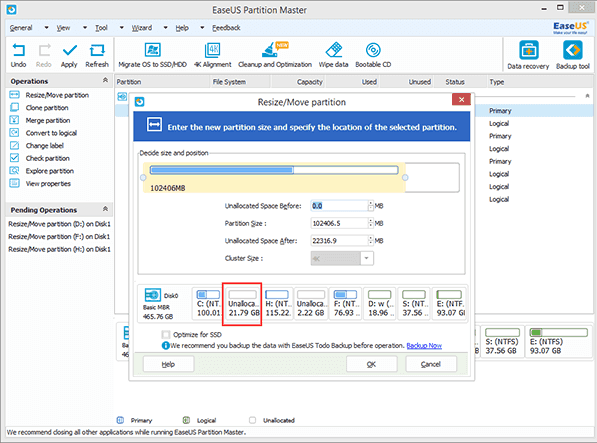
2. Right click E: partition and select Resize/Move.

Resize Partition E: on RAID

3. A popped-up dialog box indicates the current size of E: partition. The box also depicts the used and unused space on the partition and the free space surrounding the partition (if any exists); the minimum and maximum sizes that you can resize a partition; cluster size of the partition.

Resize Partition E: on RAID

4. Position the mouse pointer on the right partition handle. Drag the handle to the partition size you want when the mouse pointer changes to a double-headed arrow and click OK.

Resize Partition E: on RAID

Don't forget to apply the changes then you can have the partitions resized on this hardware RAID.

Free download EASEUS Partition Master Server Edition to partition RAID on your server computer.

For better data security, you may also use the free backup software - EASEUS Todo Backup, which will help you a lot. It provides easy-to-use interface to backup and restore your system, disk and partition within minutes.

Related Articles:

Home | Solution | About Company | Contacts | Resource | Blog | Forum | Directory | Links | Sitemap

Copyright © 2005-2010 CHENGDU YIWO Tech Development Co., Ltd. ALL RIGHTS RESERVED.

Privacy Policy | License | Legal Counsel

Partition Magic ® is a registered trademark of Symantec Corporation.